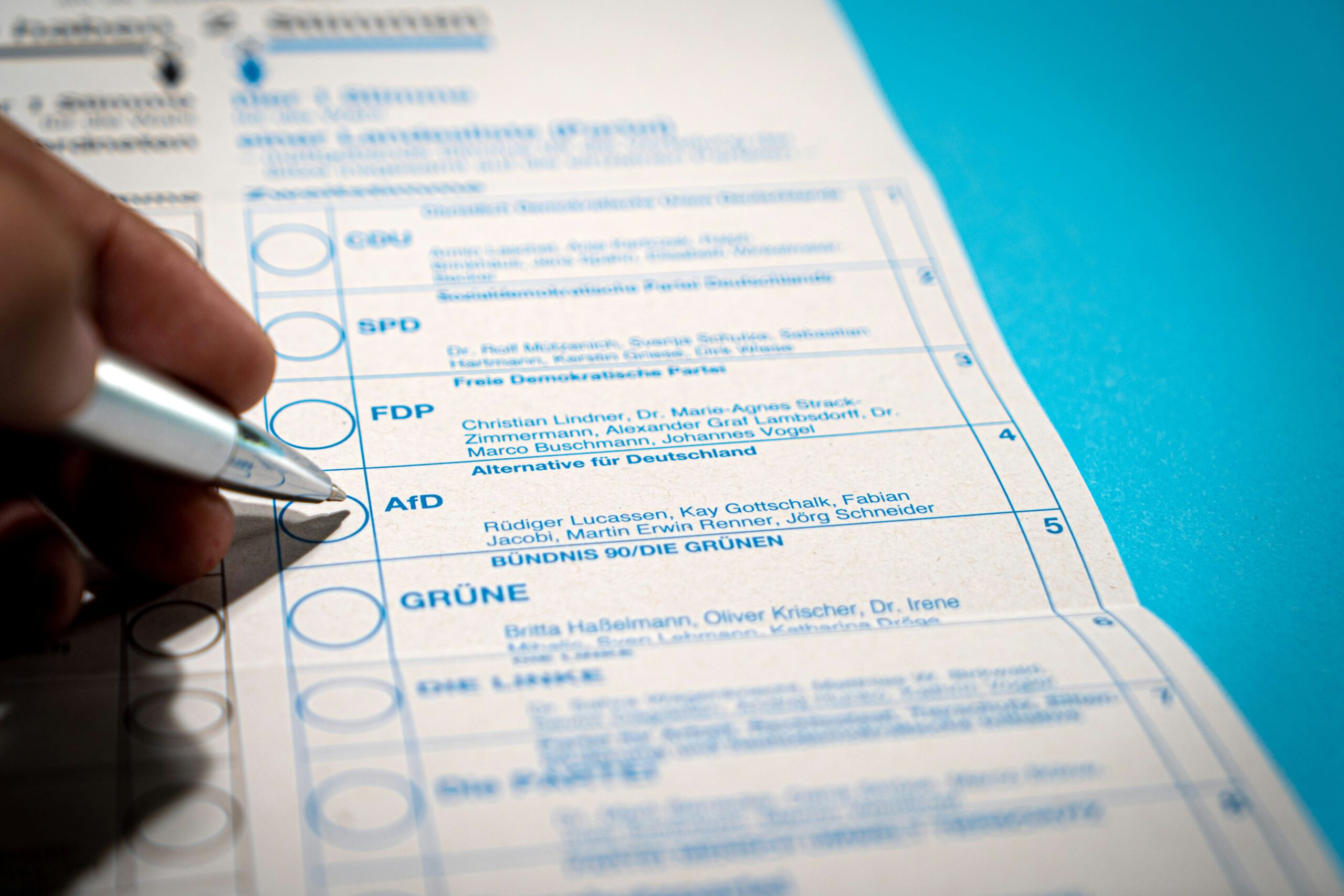
(Please scroll down for an English language version of the article)
Über die Wahl der AfD kursieren viele einfache Erklärungen. Beispielsweise ihre Wähler wären vor allem junge, arbeitslose Männer. Oder: viele würden die Partei nur aus Protest wählen. Eigentlich seien es vor allem wirtschaftlich Abgehängte. Und manche glauben, dass die AfD schnell wieder an Zustimmung verliert, sobald sie selbst politische Verantwortung übernehmen muss.
Die Forschung zeigt ein komplizierteres Bild. Die Unterstützung der AfD lässt sich nicht mit einer einfachen Erklärung erfassen. Vielmehr wirken verschiedene Faktoren zusammen, die unterschiedlich nah an der eigentlichen Wahlentscheidung liegen.
1. Wer wählt die AfD und warum?
Den einen AfD-Wählertyp gibt es nicht. Die Wählerschaft ist viel unterschiedlicher, als manche Darstellungen vermuten lassen. Junge arbeitslose Männer sind jedenfalls nicht ihr typischer Kern. Und viele Menschen wählen die AfD nicht aus Protest, sondern weil sie die politischen Positionen der Partei teilen ([1], [2]). Auch persönliche wirtschaftliche Benachteiligung erklärt die Unterstützung der AfD nur begrenzt. Wichtiger sind häufig Wahrnehmungen, die sich auf die Gesellschaft als Ganzes beziehen. Zum Beispiel, das Gefühl, dass es dem Land schlechter geht, dass die eigene Gruppe an Ansehen oder Wohlstand verliert oder dass bestimmte Menschen und Regionen nicht ausreichend gesehen werden.
Hilfreich ist es, die verschiedenen Erklärungen als eine Art Kette zu verstehen. Manche Faktoren liegen eher im Hintergrund, andere sind näher an der eigentlichen Wahlentscheidung. Im Hintergrund stehen unter anderem Unterschiede darin, wie Menschen mit Unsicherheit und Wandel umgehen. Manche wünschen sich stärker klare Antworten und Ordnung, andere kommen besser mit Widersprüchen und Uneindeutigkeit zurecht. Solche Persönlichkeitsunterschiede bestimmen keine Wahlentscheidung, können aber beeinflussen, welche politischen Deutungen man überzeugend findet ([3], [4], [5], [6]).
Näher an der Wahlentscheidung liegen politische Einstellungen. Besonders häufig findet die Forschung einen Zusammenhang mit der Ablehnung von Migration und der Vorstellung, dass der Staat in erster Linie für die einheimische Bevölkerung da sein sollte. Hinzu kommen Misstrauen gegenüber politischen Eliten, ein stärkeres Bedürfnis nach Autorität, kulturelle Abwehrreaktionen und das Gefühl, dass die eigene Gruppe gegenüber anderen verliert ([7], [8], [9], [10]).
Auch Emotionen spielen eine Rolle. Angst macht aufmerksamer, Wut mobilisiert und erleichtert es, Schuldige für Probleme auszumachen. Radikal rechte Parteien greifen solche Gefühle auf und beschreiben politische Konflikte besonders häufig als Bedrohung, Kontrollverlust oder Verrat ([11], [12], [13]).
Schließlich ist wichtig, was gesellschaftlich als „normal“ gilt. Wenn eine Partei immer erfolgreicher wird und dauerhaft in Parlamenten sitzt, kann ihre Wahl selbstverständlicher erscheinen und ein Teil des früheren Stigmas verschwinden ([14], [15], [16]).
Deshalb reicht es nicht, nur auf die Wähler zu schauen. Auch Parteien und Medien prägen, welche Themen wichtig erscheinen und welche politischen Angebote zur Verfügung stehen. Wenn etablierte Parteien Positionen radikal rechter Parteien übernehmen, gewinnen sie deren Wähler nicht automatisch zurück und können die radikale Rechte teilweise sogar stärken [17]. Auch die Übernahme ihrer Begriffe und Deutungen kann dazu beitragen, dass ihre Sicht auf ein Problem selbstverständlicher erscheint, etwa wenn Migration fast ausschließlich als Krise oder Kontrollverlust beschrieben wird [18].
2. Warum ist die AfD im Osten besonders stark?
Der Osten ist kein völlig anderer Fall. Dort wirken ähnliche Faktoren wie im Westen, einige kommen aber häufiger zusammen und treffen auf besondere historische und regionale Erfahrungen.
Dazu gehören zunächst die Lebensbedingungen vor Ort und Gefühle der Benachteiligung. Viele ostdeutsche Regionen haben über Jahrzehnte Einwohner verloren, Infrastruktur (z. B. öffentlicher Nahverkehr) wurde abgebaut und Vermögen sind im Durchschnitt geringer. Gleichzeitig geht es nicht nur um die tatsächliche Lage, sondern auch um das Gefühl, dass die eigene Region weniger zählt oder nicht ausreichend anerkannt wird. Häufig bezieht sich Benachteiligung deshalb nicht auf die eigene Person, sondern auf die Gruppe: „Uns Ostdeutschen geht es schlechter“, „wir werden weniger gehört“ oder „unsere Leistungen werden nicht ausreichend anerkannt“ ([19], [20], [21]).
Hinzu kommen unterschiedliche politische Erfahrungen. Viele ältere Ostdeutsche sind in der DDR aufgewachsen und haben nach 1990 einen tiefgreifenden wirtschaftlichen, sozialen und politischen Wandel erlebt. Außerdem sind einige Einstellungen, die mit AfD-Unterstützung zusammenhängen, im Osten stärker verbreitet. Dazu gehören etwa eine stärkere Ablehnung von Zuwanderung, Misstrauen gegenüber politischen Eliten oder die Vorstellung eines Gegensatzes zwischen „dem Volk“ und „denen da oben“. Besonders deutlich zeigt sich das bei älteren Jahrgängen ([22], [23], [24]).
Auch die Bindung an Parteien unterscheidet sich. Viele Menschen im Osten fühlen sich weniger dauerhaft an eine bestimmte Partei gebunden und wechseln häufiger zwischen Parteien oder zwischen Wählen und Nichtwählen. In manchen Regionen waren zudem schon früher rechte Parteien wie REP, DVU oder NPD erfolgreich. Dort konnte also die jetzige rechte Mobilisierung auf bereits vorhandene Erfahrungen und Strukturen aufbauen. Gleichzeitig zeigt der starke AfD-Zuspruch unter jungen Menschen, dass sich das Phänomen nicht einfach von selbst erledigt, wenn ältere Generationen irgendwann nicht mehr wählen ([2], [25]).
Der Osten ist dabei kein grundsätzlich anderer Fall. Wenn ähnliche Bedingungen auch in Westdeutschland stärker zusammenkommen, kann dort ebenfalls die Unterstützung radikal rechter Parteien wachsen.
In einem weiteren Blogbeitrag wenden wir den Blick in die Zukunft und befassen uns mit der Frage, was wäre, wenn die AfD ihren Zenit irgendwann erreicht und ihre Stimmenanteile wieder sinken? Denn bereits in der Vergangenheit haben andere radikal rechte Parteien nach großen Wahlerfolgen wieder stark an Unterstützung verloren.
English version:
Voting for the AfD: An Overview of Explanations
There are many simple explanations circulating about voting for the AfD. For example, that its voters are mainly young, unemployed men. Or: that many only vote for the party out of protest. That they are mainly the economically left behind. And some believe that the AfD will quickly lose support again as soon as it has to take on political responsibility itself.
Research shows a more complicated picture. Support for the AfD cannot be captured by a single simple explanation. Rather, various factors interact, which lie at different distances from the actual voting decision.
1. Who votes for the AfD and why?
There is no single type of AfD voter. The electorate is much more diverse than some portrayals suggest. Young unemployed men are certainly not its typical core. And many people vote for the AfD not out of protest, but because they share the party’s political positions ([1], [2]). Personal economic disadvantage also explains support for the AfD only to a limited extent. More important are often perceptions that relate to society as a whole. For example, the feeling that the country is doing worse, that one’s own group is losing status or prosperity, or that certain people and regions are not sufficiently seen.
It is helpful to understand the various explanations as a kind of chain. Some factors lie more in the background, others are closer to the actual voting decision. In the background are, among other things, differences in how people deal with uncertainty and change. Some have a stronger desire for clear answers and order, others cope better with contradictions and ambiguity. Such differences in personality traits do not determine a voting decision, but they can influence which political interpretations one finds convincing ([3], [4], [5], [6]).
Closer to the voting decision are political attitudes. Research often finds a connection with the rejection of migration and the notion that the state should exist primarily for the native population. In addition, there is distrust of political elites, a stronger need for authority, cultural defensive reactions, and the feeling that one’s own group is losing out relative to others ([7], [8], [9], [10]).
Emotions also play a role. Fear makes people more attentive, anger mobilizes and makes it easier to identify culprits for problems. Radical right parties take up such feelings and particularly often describe political conflicts as a threat, a loss of control, or betrayal ([11], [12], [13]). Finally, what is socially considered “normal” matters. When a party becomes increasingly successful and sits in parliament permanently, voting for it can appear more natural and part of the former stigma can disappear ([14], [15], [16]).
That is why it is not enough to look only at the voters. Parties and media also shape which issues appear important and which political options are available. When established parties adopt positions of radical right parties, they do not automatically win back their voters and can in part even strengthen the radical right [17]. Adopting their terms and interpretations can also contribute to making their view of a problem appear more natural, for example when migration is described almost exclusively as a crisis or a loss of control [18].
2. Why is the AfD particularly strong in East Germany?
East Germany is not an entirely different case. Similar factors are at work there as in the West, but some of them coincide more frequently and meet with particular historical and regional experiences.
These include, first of all, local living conditions and feelings of disadvantage. Many East German regions have lost inhabitants over decades, infrastructure (e.g. public transport) has been dismantled, and wealth is lower on average. At the same time, it is not only about the actual situation, but also about the feeling that one’s own region counts for less or is not sufficiently recognized. Disadvantage therefore often does not refer to oneself personally, but to the group: “We East Germans are worse off”, “we are heard less” or “our achievements are not sufficiently recognized” ([19], [20], [21]).
In addition, there are different political experiences. Many older East Germans grew up in the GDR and experienced a profound economic, social and political transformation after 1990. Moreover, some attitudes that are associated with AfD support are more widespread in the East. These include, for example, a stronger rejection of immigration, distrust of political elites, or the notion of an opposition between “the people” and “those up there”. This is particularly evident among older age cohorts ([22], [23], [24]).
Attachment to parties also differs. Many people in the East feel less permanently attached to a particular party and switch more often between parties or between voting and not voting. In addition, right-wing parties such as the REP, DVU or NPD had already been successful earlier in some regions. There, the current right-wing mobilization was thus able to build on already existing experiences and structures. At the same time, the strong support for the AfD among young people shows that the phenomenon will not simply resolve itself once older generations at some point no longer vote ([2], [25]).
East Germany is not a fundamentally different case in this respect. If similar conditions increasingly coincide in West Germany as well, support for radical right parties can grow there too.
In a further blog post, we turn our gaze to the future and address the question: what if the AfD at some point reaches its peak and its vote shares decline again? After all, other radical right parties have already lost substantial support again in the past after major electoral successes.
Literaturangaben:
[1] C. Teney, „From moderate conservatives to radical right authoritarians: attitudinal heterogeneity within the AfD electorate“, Z Vgl Polit Wiss, Bd. 20, Nr. 2, S. 7, Mai 2026, doi: 10.1007/s12286-026-00658-1.
[2] A.-S. Heinze und T. Scheuer, „Growing Up Far Right? Youth Support for the AfD in Eastern Germany“, German Politics, Bd. 35, Nr. 3, S. 485–515, Juli 2026, doi: 10.1080/09644008.2025.2587919.
[3] J. Aichholzer und M. Zandonella, „Psychological bases of support for radical right parties“, Personality and Individual Differences, Bd. 96, S. 185–190, Juli 2016, doi: 10.1016/j.paid.2016.02.072.
[4] J. Gründl und J. Aichholzer, „Support for the Populist Radical Right: Between Uncertainty Avoidance and Risky Choice“, Political Psychology, Bd. 41, Nr. 4, S. 641–659, Aug. 2020, doi: 10.1111/pops.12643.
[5] S. J. Mayer, C. C. Berning, und D. Johann, „The Two Dimensions of Narcissistic Personality and Support for the Radical Right: The Role of Right–Wing Authoritarianism, Social Dominance Orientation and Anti–Immigrant Sentiment“, Eur J Pers, Bd. 34, Nr. 1, S. 60–76, Jan. 2020, doi: 10.1002/per.2228.
[6] A. Lietz und S. J. Mayer, „Navigating uncertainty“, Personality and Individual Differences, Bd. 248, S. 113449, Jan. 2026, doi: 10.1016/j.paid.2025.113449.
[7] K. Arzheimer und C. C. Berning, „How the Alternative for Germany (AfD) and their voters veered to the radical right, 2013–2017“, Electoral Studies, Bd. 60, S. 102040, Aug. 2019, doi: 10.1016/j.electstud.2019.04.004.
[8] A. Goerres, D. C. Spies, und S. Kumlin, „The Electoral Supporter Base of the Alternative for Germany“, Swiss Political Sci Review, Bd. 24, Nr. 3, S. 246–269, Sep. 2018, doi: 10.1111/spsr.12306.
[9] P. Norris und R. Inglehart, Cultural Backlash: Trump, Brexit, and Authoritarian Populism, 1. Aufl. Cambridge University Press, 2019. doi: 10.1017/9781108595841.
[10] M. Rooduijn, „What unites the voter bases of populist parties? Comparing the electorates of 15 populist parties“, Eur. Pol. Sci. Rev., Bd. 10, Nr. 3, S. 351–368, Aug. 2018, doi: 10.1017/S1755773917000145.
[11] L. Jacobs, C. Close, und J.-B. Pilet, „The angry voter? The role of emotions in voting for the radical left and right at the 2019 Belgian elections“, International Political Science Review, Bd. 46, Nr. 1, S. 144–159, Jan. 2025, doi: 10.1177/01925121231224524.
[12] P. Vasilopoulos, G. E. Marcus, N. A. Valentino, und M. Foucault, „Fear, Anger, and Voting for the Far Right: Evidence From the November 13, 2015 Paris Terror Attacks“, Political Psychology, Bd. 40, Nr. 4, S. 679–704, Aug. 2019, doi: 10.1111/pops.12513.
[13] T. Widmann, „How Emotional Are Populists Really? Factors Explaining Emotional Appeals in the Communication of Political Parties“, Political Psychology, Bd. 42, Nr. 1, S. 163–181, Feb. 2021, doi: 10.1111/pops.12693.
[14] H. P. Selvanathan und B. Leidner, „Normalization of the Alt-Right: How perceived prevalence and acceptability of the Alt-Right is linked to public attitudes“, Group Processes & Intergroup Relations, Bd. 25, Nr. 6, S. 1594–1615, Sep. 2022, doi: 10.1177/13684302211017633.
[15] V. Valentim, The Normalization of the Radical Right: A Norms Theory of Political Supply and Demand, 1. Aufl. Oxford University PressOxford, 2024. doi: 10.1093/9780198926740.001.0001.
[16] V. Valentim, „Parliamentary Representation and the Normalization of Radical Right Support“, Comparative Political Studies, Bd. 54, Nr. 14, S. 2475–2511, Dez. 2021, doi: 10.1177/0010414021997159.
[17] W. Krause, D. Cohen, und T. Abou-Chadi, „Does accommodation work? Mainstream party strategies and the success of radical right parties“, PSRM, Bd. 11, Nr. 1, S. 172–179, Jan. 2023, doi: 10.1017/psrm.2022.8.
[18] T. Völker, „How the media cordon sanitaire crumbles: lessons from Germany“, Political Research Exchange, Bd. 8, Nr. 1, S. 2621808, Dez. 2026, doi: 10.1080/2474736X.2026.2621808.
[19] K. Arzheimer und T. Bernemann, „‘Place’ does matter for populist radical right sentiment, but how? Evidence from Germany“, Eur. Pol. Sci. Rev., Bd. 16, Nr. 2, S. 167–186, Mai 2024, doi: 10.1017/S1755773923000279.
[20] B. Höhne, J. Kölzer, und H. Träger, „Geography of Shrinkage: Local Population Decline and Electoral Support for the Anti-establishment Parties AfD and BSW in East German State Elections“, German Politics, Bd. 34, Nr. 3, S. 449–477, Juli 2025, doi: 10.1080/09644008.2025.2489409.
[21] G. Pickel und S. Pickel, „The Election of the AfD and the Collective Identity of East Germans – Between Perceived Disadvantage and Collective Deprivation“, German Politics, Bd. 35, Nr. 3, S. 412–436, Juli 2026, doi: 10.1080/09644008.2025.2605686.
[22] M. Pesthy, M. Mader, und H. Schoen, „Why Is the AfD so Successful in Eastern Germany? An Analysis of the Ideational Foundations of the AfD Vote in the 2017 Federal Election“, Polit Vierteljahresschr, Bd. 62, Nr. 1, S. 69–91, März 2021, doi: 10.1007/s11615-020-00285-9.
[23] S. Kailitz und S. Rippl, „Same Seeds, More Fertile Ground: Sources of AfD Dominance in Eastern Germany“, German Politics, Bd. 35, Nr. 3, S. 437–462, Juli 2026, doi: 10.1080/09644008.2026.2682305.
[24] S. Mau, Ungleich vereint: warum der Osten anders bleibt, Originalausgabe, 4. Auflage. in edition suhrkamp Sonderdruck. Berlin: Suhrkamp, 2024.
[25] J. Kölzer, M. Debus, und C. Stecker, „Alte Wurzeln, neue Wurzeln? Zum Einfluss früherer rechtsradikaler Unterstützung auf den AfD-Wahlerfolg bei der Europawahl 2024“, Polit Vierteljahresschr, Bd. 66, Nr. 4, S. 847–865, Dez. 2025, doi: 10.1007/s11615-025-00590-1.